
Is your internal audit function adding real value?
25 November 2026 · 7 min read · Amumpaire · 6 views

The UGX 148.6 million payment that exposed a bigger problem
At 8:26 a.m. on Monday, 19 October 2026, the finance director of a medium-sized logistics company based in Namanve, Bweyogere, received a call from a transport contractor demanding payment for services delivered three weeks earlier, and although the accounting system showed that UGX 148.6 million had been paid the previous Friday, complete with an approved invoice, payment voucher and electronic authorisation from two senior officers, the contractor insisted that no money had reached its account.
By 10:00 a.m., the managing director had summoned the finance manager, procurement officer and internal auditor, who all arrived with documents showing that the payment had followed the approved procedure, and he then asked the internal auditor a question that should trouble every audit committee in Uganda.
"We spend millions every year on internal audit. You reviewed procurement last quarter and gave us a satisfactory report. How did UGX 148.6 million disappear through a process you assured us was working?"
The auditor explained that all the required approvals had been obtained, the finance manager agreed, and the procurement officer pointed to the invoice, yet nobody could explain why the supplier had not received the money.
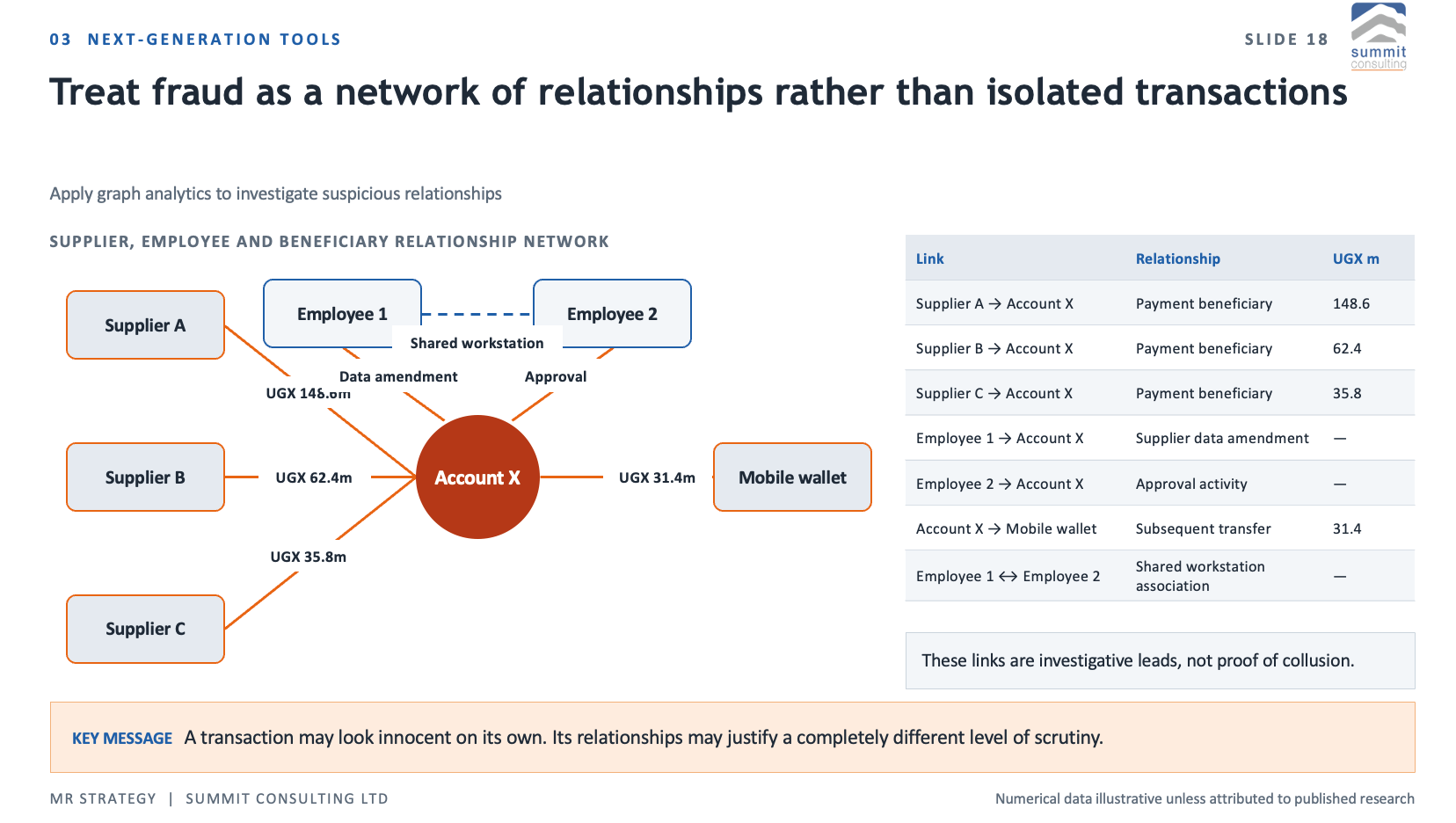
This is an illustrative composite case, constructed from common fraud and control failures rather than presented as an actual incident involving an identifiable organisation.
The problem was not the missing money
The real problem was an internal audit function that had confused evidence of compliance with evidence of effective control, because the auditors had reviewed vouchers, confirmed signatures and checked policy compliance without testing whether employees could manipulate the underlying information before it reached approval.
In the illustrative case, the board engages Summit Consulting Ltd to carry out an independent forensic examination alongside legal counsel, and the investigators begin with the supplier master file, payment approval logs, email records and transaction history.
They establish that the contractor's bank account details had been changed shortly before payment by an authorised user and approved by another account within three minutes, and although the system showed two usernames linked to the same workstation, that did not establish who physically operated the computer, since shared credentials, an unattended session or unauthorised access all remained possible.
The question was no longer whether the signatures existed. It was whether the systems and people behind them could be trusted.
Why your internal audit reports may be misleading
The auditors had reported that procurement compliance was satisfactory, payment approvals were adequate, segregation of duties existed and supporting documentation was complete, and every statement could have been technically correct while the control environment remained vulnerable.
A useful auditor would have asked whether supplier bank details could be changed without independent verification, whether approval credentials were shared, and whether suspicious changes generated alerts, and a stronger audit would have tested the entire population of supplier-account amendments rather than a sample of completed payments.
The difference is simple: a compliance-focused auditor asks whether a procedure was followed; a value-adding auditor asks whether the procedure can be defeated.
Management can follow a weak procedure to the letter and still lose a great deal of money.
Internal audit cannot guarantee the absence of fraud, but it must provide independent, risk-based assurance that governance, risk management and controls are properly designed and operating effectively, which takes professional scepticism, technical competence and the willingness to challenge senior management.
The evidence was disappearing while management demanded answers
Back in Namanve, the managing director wanted immediate disciplinary action against the officers whose accounts appeared in the transaction history.
The investigators advised against premature conclusions, particularly because one employee had already deleted several WhatsApp messages as personal, an IT officer had been told to reset a workstation and a manager wanted the suspected employee's laptop opened immediately, all of which could compromise evidence before anyone understood its significance.
The proper response was to preserve email messages with their headers, cloud audit records, original documents, access logs, device records and payment instructions, recording where each item came from, who handled it and when, while examining authenticated and integrity-checked forensic copies in place of originals wherever practicable.
A screenshot might demonstrate what appeared on a screen, but it would not automatically establish who created the message, whether it was complete or whether its contents had been altered.
Uganda's Electronic Transactions Act recognises electronic records as potential evidence but stresses authenticity and the reliability of how they are generated, stored and communicated, so the company's lawyers needed a defensible account of how every important record had been obtained and preserved.
An employee's username is not proof of an employee's conduct, and a convincing screenshot is not proof of a genuine instruction.
Investigators who forget this rarely survive cross-examination.
How the investigation exposed the control failure
The investigators reconstructed the transaction instead of accepting the accounting entry, and found that the original supplier registration showed one bank account, the amended record showed another, the payment file matched the amended account, and the genuine contractor confirmed through an independently verified contact that it had never requested the change.
They then tested the approval sequence against system activity, workstation records, duty schedules and communications, which showed that Suspect 1, an accounts employee, had access to the supplier database and Suspect 2, a procurement employee, took part in approval, facts that justified further examination but not an automatic finding of guilt.
Lawfully obtained financial records in the illustrative investigation traced the UGX 148.6 million through an initial receiving account, followed by UGX 49 million in cash withdrawals, UGX 31.4 million dispersed through mobile-money transfers and UGX 68.2 million in further bank transfers.
The investigators still had to establish the ultimate beneficiaries, whether the account holders acted knowingly and whether internal collusion could be proved, but what mattered for internal audit was that the critical control had failed long before release because the organisation had trusted the approval workflow without examining who could change the information being approved.
How to measure whether internal audit adds value
The board should stop measuring internal audit primarily by the number of reports issued, assignments completed and recommendations accepted.
The Institute of Internal Auditors' Global Internal Audit Standards, effective from January 2025, require risk-based planning, performance measurement and follow-up on corrective actions.
For this company, a meaningful audit committee dashboard would measure how much assurance work addresses the organisation's highest risks, how quickly critical exceptions reach decision-makers, how many repeat weaknesses remain unresolved and whether management's corrective actions have been independently tested.
The audit committee should also examine whether auditors use data analytics to identify unusual transactions, duplicated suppliers, suspicious changes to beneficiary details and conflicts between user permissions.
A valuable internal audit function helps management identify weaknesses before they become losses, provides reliable evidence when something goes wrong and gives the board an independent view of whether corrective action has actually worked.
It does not manage the controls it audits, approve management's decisions or replace a properly authorised forensic investigation, and its independence is part of its value.
What to do before the evidence goes cold
When suspicious activity emerges, the internal auditor should ensure that the authorised response team takes the following steps:
- Preserve the source records. Secure relevant email data, transaction histories, audit logs, original documents and devices before routine deletion or changes affect them.
- Establish a timeline. Reconcile the sequence of approvals, account amendments, communications and fund movements using verified timestamps.
- Verify independently. Contact suppliers through previously validated channels and obtain bank confirmations through lawful procedures.
- Protect evidence integrity. Document custody, record acquisitions, calculate appropriate integrity hashes and restrict access to preserved material.
- Assess competing explanations. Distinguish deliberate misconduct from system compromise, credential sharing, processing errors and innocent activity.
- Escalate and contain. Notify the authorised management and board representatives, involve counsel where necessary, and address immediate exposure without destroying evidence.
The lesson for audit committees
In this case, the UGX 148.6 million payment was the visible failure, while the deeper failure was an organisation that had invested in assurance and received reassuring reports without testing whether its most important controls could be trusted, and that should change how directors assess internal audit performance.
Do not ask your chief audit executive how many findings were raised this quarter but which important risks have become better controlled, which critical assumptions have been independently challenged, and what evidence proves that management's actions are working, and when an incident occurs, demand disciplined investigation rather than convenient explanations.
In modern investigations, truth is not found by collecting more data. It is found by preserving the right data, in the right state, with the right context, before people start explaining it away.
Copyright Institute of Forensics & ICT Security 2026. All rights reserved.



Comments
No comments yet. Be the first to share your thoughts.